
PIECEMEAL: Chapter 4--You Will Know It
"You don't have to be good."

The call came in as Micah made his usual rounds around downtown the next morning.
Loud radio static startled him out of his thoughts, and Grant’s voice came blasting through the receiver.
“Unit twelve, copy.”
He jumped, stilled his rapidly beating heart, and picked up the receiver. “Go ‘head.”
“Abandoned vehicle off CR 7 near mile 3. Can you take a look?”
“On my way.”
“Roger Roger.”
He pulled out, the engine rumble travelling up his body from his boots to the crown of his head. As he turned onto Main, he passed the Douglas Diner again. Through the window, he saw Melissa leaning over Eli’s plate, her head close to his, their two profiles matching each other almost exactly until the door opened and she turned away.
He sighed, remembering the crayon drawing Eli had given him the day before, the one that rested on his passenger seat. He tried not to look at it, told himself the boy just had a good imagination, that strangers came and went, and most of them left quietly. He told himself the muggy rain smell, unusual for November, was just a one-day fluke.
He told himself a lot of things; whether or not he believed them was questionable.
He merged onto the county road, and suddenly felt the air outside the car shift. A strange pressure pounded his left side, the sound of the trees whistling past him through the open driver’s side window. It leaned in close, circling the car; and though his speed never changed, he could’ve sworn the car moved slower, as if driving through molasses. His left ear rang, and instinctively understood that whatever surrounded the car watched him. It rippled through his body like a stone dropped in a creek, the sense of being observed, assessed, measured by some cosmic yardstick he hadn’t known existed.
It lasted only a moment, just as long as it took to merge onto the county road. When it passed, he exhaled and it felt like release, as if he’d been holding his breath. He glanced in his rearview mirror and saw only rows and rows of needle-thin douglas pines. The hairs on the back of his neck tingled. Maybe it was the way the mirror shook with the engine rumble; maybe it was a trick of his eyes, some remnant of that bizarre pressure he’d just felt—but he could’ve sworn the forest expanded and shrunk rhythmically, like lungs breathing, like a heart beating.
And walking casually along the poor excuse for a shoulder, a silhouetted figure. Broad-shouldered, straight-backed, sauntering carelessly but purposefully, as if they knew where to go.
Micah blinked hard, shook his head a little. He adjusted his mirror and slowed the car so he could see more clearly. When he looked again, the figure was gone, the trees were just trees, and the watchful presence felt more like a memory of a dream than a recent reality.
A pit began to yawn in his stomach. Whatever it was that approached, he was sure, though he could not have said why, Gray Falls itself would be lodged in its jaws soon enough.
He reached Mile 3 with relative ease. The pines leaned in close, tilting toward him on both sides of the two-lane road, as if waiting to pull him in. He rubbed his eyes, and the impression dissipated like ash floating on the wind.
Cold wind through his open window pierced through his layers of fleece and flannel, the icy leather of the seat beneath him spread through his pants, and he shivered. He turned up the ancient heater a couple notches, and it coughed out hot-adjacent air.
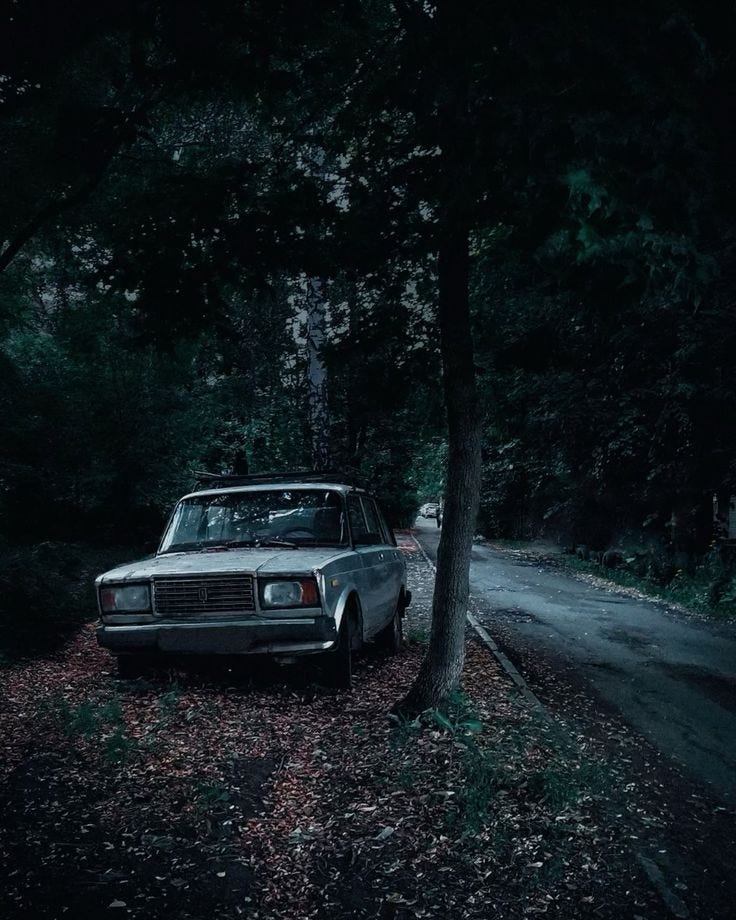
The abandoned car was easy enough to find, despite its owner’s obvious attempts at concealment. It was an ugly, bronze sedan, the paint chipped in places, with no make or model, or even a brand logo. No license plate either. He sighed. This was going to be more difficult than he thought.
He parked right next to the ditch, angling the truck for cover and putting his lightbar on low with no siren; he already had to do too much paperwork for the abandoned vehicle, he didn’t want to total his own, as well.
Micah took his time walking along the edge of the ditch, keeping his body language calm, his hands visible; he was certain no one was around, but he wanted to play it safe. The sedan was old, well-worn; midrange, four-door. Nothing remarkable about it, except for the missing plates.
He carefully picked his way into the ditch, and made a slow circle around the car, frowning slightly. Placing a hand on the hood, he found it cold. All the windows were rolled up, no broken glass to be found. There was only a shallow furrow where the tires left the asphalt and settled into the dirt.
The drivers’ side door was locked, and a peer through the window told him there were no keys, or at least none that he could see. In the backseat, someone had left a coat, thick, dark wool with a soft sheen. In the passenger seat, a bottle of wine, unopened, so old the label had faded and become entirely unreadable, its dark green glass reflecting some of the gray light through the windshield, blinding Micah for a moment.
He climbed back out of the ditch and stood staring down at the car with his hands on his hips, lost in thought. Everything about this was so everyday, and yet nothing made sense. It rang uncanny through Micah’s body.
How did the car get in the ditch, with no evidence of a crash? Who would leave a coat in the car in one of the coldest months of the year? And why leave an expensive bottle of wine in the front seat, practically beckoning someone to take it?
Giving up, he picked up his radio from the car and reported his findings—if they could even be called findings—to Grant.
“Huh,” the other man said, just as perplexed as Micah. “And there was no wallet or anything left in the car?”
“Not that I could see. All the doors were locked, and the windows were rolled up.” There was a short pause. Then Micah asked, “There’s no plates, but did anyone report a stolen vehicle recently matching its description? Do we know anything about who called it in?”
“Call came anonymous, didn’t leave a name or a number to call back. Just gave the road and mile number with a short description of the vehicle. I didn’t recognize the voice; it was a man, gravelly and like he was in pain, but nothing else. I checked, we found nothing stolen matching its description.”
“Thanks.”
Micah slid back down the ditch, and tried the doors again. Still locked. He had tools in the truck that could open it without making a mess, but he wanted to look around a bit more. The ground was stiff with frost and gave no sign of being disrupted: no footprints or trail. The long, brown, wind-whipped grasses leaned one way and then the other, the only disturbance where the sedan pressed them down. Just like the car’s placement as if someone had simply picked it up and dropped it in the ditch, it seemed like whoever had left had done so by simply vanishing into thin air.
On a whim, he peered through the driver’s side window one last time, and jumped. On the passenger seat, tucked under the bottle of wine, was a single piece of paper. Heart pounding, he slid over the hood to the passenger side and took a closer look at the paper. Printed on the surface, in gothic bold-faced letters: COMMUNITY SING—HYMNS & HARVEST—THURS 7 PM AT ST. VITUS’.
For a moment, Micah froze, staring at the flyer. Very little of this entire situation made sense before, and the paper complicated it even more. It hadn’t been there before, he knew for certain. So where did it come from?
A distant chainsaw buzz cut through the tense silence, followed by a high, shrill shriek. Like the trees were screaming. He flinched, remembering childhood tales whispered at a sleepover. How midnight treks into the Needle Pines, bright silver moonlight cascading through the canopies, suddenly metamorphosed the trees into figures frozen in a sort of dance. Micah shook his head, trying to clear it; those were just silly legends, not real stories.
The silence stretched, and the longer Micah stood, fixated on the flier, the more he realized it wasn’t completely silent. To his left, the forest churned out its own slow noise— birdsong, leaves rustling, other strange sounds that could be an animal or something worse. Complete silence was a rarity in Gray Falls; always, rumbling beneath it like musical accompaniment, engine gargles, far-off laughter and greetings among neighbors, the clack of heeled boots against concrete.
All this Micah comprehended, though distantly. He couldn’t tear his eyes from the church handbill. The paper trembled slightly in his hands. He remembered attending such events at Vitus’ as a child, bouncing to the beat next to his mother, small hand in hers, practically shouting tunes to hymns he didn’t recall learning but somehow memorized.
Along the margin, in the same small pencil script he’d noticed behind the library, someone had written: you don’t have to be good.
His breath came in ragged, shallow gasps. The paper crinkled within his clenched fists. He turned it over in his hands, checked both sides, but found nothing else. When he returned it to its original orientation, the writing was gone, only a faint lead smudge where it used to be.
He flung the paper to the ground and clambered out of the ditch, his vision tunnelling and hands trembling.
By the time his shift tapered to its dull end, the November cold had leached into the marrow of the day. He signed off, changed back into his off-duty clothes, and drove home with the heater on high and the drivers’ side window rolled down.
His street was silent when he pulled into the driveway. The night sky was tinged gray with cloud cover, and the streetlights cast dim, sickly yellow light in insufficient rings every few feet.
The house waited, broad-shouldered against the dark, looming with the patient certainty of a man who expected obedience above all else. It towered over him, taller than he remembered, its windows hollow as empty eye sockets. Even vacant, it managed to look disappointed. Only the chirping and buzzing of insects, the hooting of a distant owl, and the thin, insistent burble of the creek behind his property accompanied him inside.
Once inside, he hung his jacket on the back of the kitchen chair, and sighed as he looked around the first floor. Nothing had changed, not since he was a child. The kitchen still opened into the cramped dining room, the same worn table tucked beneath the window, the same sagging couch facing the television in the living room. Dust had settled over everything in a fine gray film, softening the edges and muting the colors without making the place feel any less familiar.
His shoulders tightened before he realized they had, and he paused, listening to the quiet as though he’d forgotten it belonged to an empty house. Every room waited with the patient stillness of a held breath, and the silence seemed to gather around him instead of settling. He had the strange urge to justify standing where he was, as if he’d been caught doing something wrong, catching himself mid-glance toward the staircase before he remembered there was no one left. A heartbeat later, it was gone.
Micah shook his head, clearing it. “Get it together,” he whispered to himself. He rubbed his face with his hands, and made his way into the kitchen.
Before he could talk himself out of it, he opened the cabinet above the fridge, and reached for the glass and bottle he knew would be there. His father’s whiskey. He’d never moved them, and never even opened this cabinet until now. The glass wasn’t a fancy one; thick-bottomed, heavy, the rim permanently nicked and discolored in some places with age.
He brought out a large cube of ice from the freezer, dropped it in the glass, and poured two fingers of whiskey. The first sip hit hard, thick and bitter; he sputtered and almost gagged. He always hated whiskey. The second sip went down easier, the third much more than that.
Micah walked into the family room and dropped himself into his father’s old La-Z Boy. For a second, he braced himself for the sharp warning to get up, but nothing came. He leaned back, letting the whiskey glass dangle from his fingers.
Directly across from him, above the custom bookshelf his father had built into the wall, racks of antlers and stag heads watched the room with their glassy black eyes. The tips of their prongs threw long, bizarre shadows across the room. When he was small, the shadows had frightened him, his reflection in the glassy eyes unsettling him.
He remembered watching his father, sitting cross-legged on the living room carpet like a child at storytime, tools scattered all around him, carving the wood mounts, polishing the bone until they gleamed. The sharp, itchy plastic stench of hot glue wafted up the stairs into his bedroom.
It was always the smell that brought him downstairs, as if a summons. And it was always the same sight that stopped him in his tracks. His father, more at peace than Micah had ever seen him, hands steady, voice soft in a way he hadn’t known was possible. He’d beckon Micah over excitedly, pulling him down to join him on the carpet no matter how old he was. And always, Micah would start turning away when his father prepared to put their new eyes in; and always his father would lightly grab his arm and keep him in place.
“Don’t look away,” his father had said once, whispering as if the animals could still hear and be scared off. “You’ll miss the moment they remember what they are.”
Now, years after the last time he’d watched his father hang new hunting trophies, Micah looked up at the racks.
“How much of you is in me?” he asked quietly, unsure if the ‘you’ was his father, the antlers, or the town.
He spoke the words before the thought fully formed, and when it landed, they seemed to detonate. Fear, of what he couldn’t describe, ricocheted through him, startling the glass from his hand. It landed at just the right angle against the hardwood floor, the sound bright and final. Shards skittered in all directions.
“Damn it!”
He crouched and reached for the largest piece, which had landed beneath the armchair, a crescent moon shape with a chunk of the thick bottom and a razor-thin rim. As he got up, it slid across his palm, causing him to hiss. Blood dotted immediately along the line, dark red and eager.
He stalked into the kitchen, set the shard on the counter and held his hand over the sink. The cut was clean but deep, and blood kept dripping from it like a nosebleed.
A single bead gathered at the corner of the wound. Micah watched it expand like a balloon and then roll into his palm, spreading through the lines on his hand.
And then he wasn’t just in the kitchen anymore, but also floating somewhere else. The air warmed, the light dimmed and yellowed, intimate and close.
Piece by piece, the shape of a person kneeling in front of him revealed itself, like removing a tarp slowly. The image felt right, certain, as if on their knees in front of him were precisely where this person belonged.
Breath at his wrist, small mouth sounds. His own breathing came ragged. The figure cupped his injured hand in theirs, gazing up at Micah with soulful, sorrowful eyes. Slowly, as if the image were projected through molasses, the figure’s tongue met the surface, sapping up the blood pooling in his palm gently. Heat travelled up his arm like a fuse, starting at his fingertips and ending at his shoulder, where it spread through his entire body. He felt like he had been lit on fire.
The figure kept licking the cut on his hand, and Micah’s head lolled back, eyes closing, a groan escaping his mouth before he knew it had gathered. He knew this mouth, he thought, recognized the shape and weight of the tongue the way you know the rest of a song after the first two notes. The figure’s face, though, remained hidden, protected by the angle of this moment—or is it a memory?
His hand trembled in the other’s grasp, and the figure responded by whispering something unintelligible but consoling, gripping Micah’s hand just that much tighter.
A part of Micah wanted to say a name. The mouth, the kneeling, the fragmented person before him—all rang with familiarity, but the syllables slipped away like water through his fingers. The desire, the wanting, made his chest ache in a way he had not felt in years.
Eventually, after what felt like hours, the hand, the tongue, the warmth, the memory receded, and when he opened his eyes, he found himself still in his kitchen. The sink was a sink again and water ran down his palm, the cut now just a pale pink line across his hand.
He found the paltry first aid kit his father had kept in an old cookie tin in the cabinet above the sink, bandaged his hand, and went in search of the broom he could never find.
While he swept the broken glass from the floor, the deer heads kept their glassy, uncanny watch from the wall, antlers casting broad, creeping shadows across the living room furniture. Like spindly hands, desperately reaching for him.
He gathered the glass into a small pile, and hissed at a sudden pain in his hand. The bandage had started spotting in neat dots. On the side table beside his father’s old chair, the whiskey bottle stood straight and unjudging, the circular stopper and the bottle’s rounded corners making it look like a small, transparent soldier standing at attention.
The memories of the abandoned sedan, the coat in the backseat, the wine bottle with its unreadable label, the handbill—all resurfaced as he and the whiskey bottle stared at each other in quiet recognition.
Through the open window in the living room, a scent wafted on a gentle breeze. Not quite rot, and not quite fresh either, like wine at the moment of turning. The sharp sting of vinegar, the heavy, mustiness of wet cardboard. The breeze carried a faint sound with it, too. Not a melody, just a single held note like a song trying to remember what comes next.
Not music. Me.
The voice that sounded through his head was not his own. It was deep, resonant, with a playful lilt that made Micah’s stomach drop. He turned so fast the air whistled like an arrow released from a bowstring. No one was there, just the silent normalcy of the kitchen, and the ever-reaching silhouettes of the antlers.
A chuckle echoed in his mind, again not his own.
“Stop it,” he said out loud, not sure if the words were directed at himself or something else.
Micah shook himself off and tapped contents of the dust pan into the trash, listening to the glass shards landing on each other like ice cubes in a drink. He cleaned the sink, making sure no trace of blood remained in the basin before climbing up the stairs to his room.
He paused before the master bedroom, the door ajar. Hadn’t he shut it after cleaning several days ago? The memories gathered before he could answer his own question. The shape of the dresser where a fist had landed, the window that used to rattle during arguments, the bed with the mattress that remembered every weight pressed against it. The room wore the memory of his father the way a coat wears a shoulder. Micah could almost hear the exasperated sighs through the nose, the strange click of the hardwood floors when his father’s stride meant the belt came after.
And then—because memory is not a thing you can always control—his mother arrived, too. It was hazy, blurry, like the dream of the boy, faded with age like a photograph left in a drawer. He had very sparse and few memories of his mother; he had been young when she died, young enough to still be protected from the seriousness of her sickness and the aftermath of her passing. But this one, for some reason, remained sharp and clear, as if it had happened yesterday.
She sat at the foot of the bed, a laundry basket by her feet, folding his little shorts and shirts into quiet stacks. She hummed a tune with no words, mid-afternoon sun filtering through her long, wavy, red hair, turning the light orange.
The hum threaded forward through years of fabricated memories built on what others have told him, and found him standing in front of the closed master bedroom door. He let the thin thread of it twine itself around his heart, reaching a hand up to meet it above his clothes.
For a moment, he imagined her turning her head and spotting him in the doorway, the way mothers in old stories can sense their sons even in the dark—there you are— and the thought landed soft as her hand cupping his cheeks.
For the second time that night, Micah muttered, “Stop it,” to the air. He reached forward and pulled the door against the jam, ensuring both the door and his memories remained sealed.
In his own bedroom, he sat on the edge of the bed long enough to convince his breath to return to normal. The hum from his mother’s memory had followed him like a shade, and it snaked beneath the silence. It hadn’t grown in volume, just clarity, and he found himself humming along to the song.
He stood to pull back the covers, and froze. A sheet of paper lay on the bedspread, directly behind where he had just been sitting, though he swore there hadn’t been anything there when he sat down. It was a small purple sticky-note, the surface crowded with penciled words, almost entirely unreadable. The lead smeared beneath his fingertips. It was the same tidy script he’d seen on the church handbill that morning, but this time, there were more words than before.
youdon’thavetobegoodyournameisafullsentenceyouwillknowityoudon’thavetobegoodyour nameisafullsentenceyouwillknowit.
Over and over, the words layered atop one another and crowded into every blank space until the entire surface was almost black with writing.
He brought the paper closer to his face, and for a breath, caught the same rotting-wine smell from the window downstairs, and then it was gone, like a word swallowed when the band begins playing.
With shaking hands, he set the paper on the nightstand, face down without meaning to, climbed into bed, and turned out the light.
He kept his eyes shut, though he felt much too wired to sleep, and beneath his closed lids, his eyes kept moving, replaying the day’s events over and over, trying to find something he might have missed.
What is happening to me?
The thought echoed every memory from the previous day, accompanied by the near-silent reverberation of his mother’s song, the beat matching itself to the throb of the wound in his palm.
Just before sleep took him, the paper on the nightstand whispered once, lifting in an invisible breeze, and then stilled.
About this project:
PIECEMEAL is horror novel and contemporary retelling of The Bacchae, an ancient Greek tragedy, which I have chosen to serialize here chapter-by-chapter as I complete what I hope is the final draft.
Set in the dead-end logging town of Gray Falls, Oregon, the novel follows Deputy Micah Grieves as a series of strange and disturbing disappearances coincides with the arrival of a magnetic stranger whose influence spreads through the town like a goblet of spilled wine. What begins as an investigation slowly morphs into something more bizarre—a story about repression, ecstasy, grief, identity, and the terrifying possibility that the ancient gods never truly left our world.
Expect slow-burn eco-horror, queer themes, creeping dread, body horror, surreal imagery, and a touch of cosmic weirdness. Think True Detective, Twin Peaks, The Ritual, and Greek tragedy beneath sap-dripping evergreens (or is it blood?)
Content Warnings (series-wide): body horror, general violence, psychological horror, religious imagery, homophobia, internalized homophobia, emotional and physical abuse (historical), grief, gore, and themes of repression and identity.
If you’re new here, be sure to check out the previous chapters, so you have the full context: Prologue (Parodos), Chapter 1: Water Poured into Wine, Chapter 2: A Fistfull of Light, First Stasimon.
Thank you for tagging along with me on this terrifying, tragic journey! Have a great rest of your week <3