
Recognition Is Not Ownership
On queer romance, straight women, and the ethics of being moved

“We’re on the same side.”
(Heated Rivalry, Rachel Reid)

The Feeling Arrives First
I loved Heated Rivalry immediately.
Not just the story itself, but the care behind it: the performances, the chemistry, the sense that the show knows exactly what it’s doing and who it’s doing it for.
I haven’t read the books yet (they’re on their way to me now!), but I’ve loved seeing how fans of the books are proud of this adaptation, both the things that were changed and the parts that remained the same.
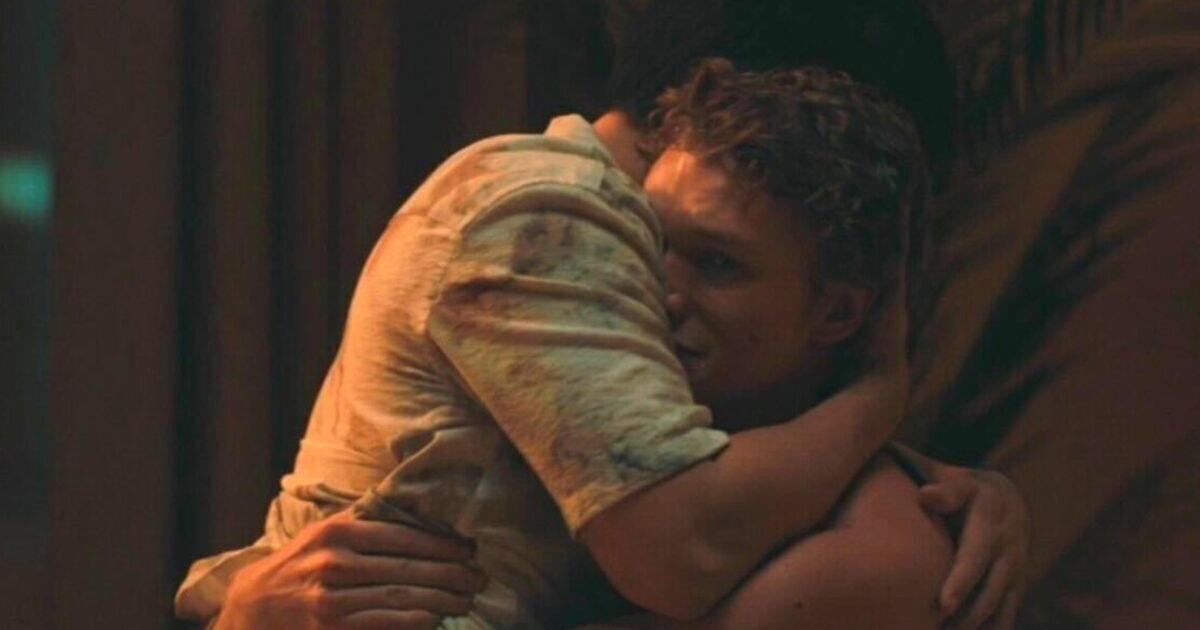
The fact that Jacob Tierney (HR’s director), the cast, and the crew brought the show together in less than 40 days and it looks and feels so stunning and perfect is simply mind-blowing. (Just look at the screenshot above. The composition! The lighting! The acting you can see even though they’re in silhouette! Oh my!)
The show feels intentional in a way so much romance media doesn’t. There’s a confidence to it, a refusal to apologize for both its tenderness and its intensity, that I found myself deeply grateful for as a viewer.
And of course, I’ve been loving the clips of especially the main two actors, Hudson Williams and Connor Storrie, in interviews. “Bring in the first ginger ale” and “I’m ninety percent butt, y’all” have been constant vocal stims for me. (Notice how they’re both Connor Storrie quotes…lmao)
Which is why, as the show made its way through my feeds (and stayed there—it’s been more than a week and still every other video on my FYP is about Heated Rivalry), I wasn’t surprised to see people—especially straight female viewers/fans— trying to articulate why it hit so hard.
One comment in particular stopped me. I don’t remember what the original question was, but the comment is written like an answer to something. I don’t remember who wrote it, either; my screenshot cut off the person’s handle—but the sentiment has lingered with me:
It’s because we as women just want to be on an equal emotional and social
standing as men. Not to be considered lesser than (or even greater than) men,
or be responsible for the emotional baggage of the relationship.
Another, much longer, post proclaims this even more perfectly (again, I could not find any information about the creator):
I think the reason so many straight girls who are obsessed with Heated
Rivalry feel gender envy is because Shane and Ilya’s relationship exists
outside of gender entirely. Their love doesn’t ask who is the man or who
is the woman… In many straight relationships, gender quietly stands
between people… Even when love is real, roles linger… Watching Shane
and Ilya, there is no gap. Their emotions move freely between them… Neither has to perform a version of love shaped by centuries of expectation. They meet each other on equal ground, and that equality allows for a level of intimacy that feels almost radical. ... Heated Rivalry doesn’t just tell a love story—it reveals what love can look like when gender stops interrupting it. And once you’ve seen that, it’s hard not to grieve the ways so many of us have been taught to love smaller than we could.
I feel both in my chest.
As a woman who has dated men, I recognized it immediately: the exhaustion of asymmetry, the quiet labor of emotional management, the way heterosexual romance so often asks women to carry more — more care, more compromise, more patience — while calling that imbalance love.
Watching a romance unfold between two men, neither of whom is positioned as lesser, neither of whom is expected to absorb the other’s emotional fallout by default, can feel almost disorienting in its relief. Not because it is idealized, but because it is level. A romance between equals. No misogyny to work around. No gendered expectations to overcome or negotiate our way through.
That recognition matters. It names something real. And it explains, at least in part, why so many straight women find themselves drawn to queer romance—on the page, on screen, in fandom spaces that bloom almost overnight around stories like this one.
I come to this conversation from the middle ground. As a queer woman, I am deeply moved by the beauty and care of queer representation in recent years, especially work centered on gay men. Heartstopper; Young Royals; Heated Rivalry; Red, White & Royal Blue: these stories (and so many more—post coming soon on queer romance recs!!) are tender, deliberate, and breathtaking in their refusal to treat queer love as either tragedy or spectacle. They are, undeniably, healing.
But healing is not the same thing as ownership.
Even when I see myself reflected, even when something in me exhales while watching or reading, I try to keep a conscious distance. Not because the feeling is false, but because it is not the point.
These stories are not written to me, and they do not need to be claimed as mine in order to matter. If anything, their power lies in the fact that they do not bend toward me at all.
That tension — between recognition and restraint — is where I want to linger.
From Feeling to Ownership
Not long after I saw those posts about gender equality in HR, another post crossed my feed.
Sharper, more confident, and much more unsettling in its implications (and explications, if I’m being honest). It framed itself as a hot take, a theory refined down to a single declarative sentence:
Heated Rivalry is made for straight women, and I might go so far as to say
it is the first TV show actually made for women.
I understand, at least logically, where that conclusion came from. I even recognized the path that led there. When something finally offers relief from a structure that has long caused harm, it’s tempting to name that relief as intention. To believe that because a story feels like an answer, it must have been written as one.
But that leap — from resonance to authorship — is where something essential gets lost.
The problem with that framing isn’t simply that it’s inaccurate. It’s that it quietly shifts the center of gravity. What begins as a response to misogyny in heterosexual romance becomes, instead, a claim over queer narrative space. A story about gay men loving each other — in bodies, in histories, under social conditions that are not interchangeable with women’s — is reframed as a corrective tool for straight women’s dissatisfaction. The text stops being about who it is actually for, and starts being measured by how well it serves someone else.
This is where the language of “healing” grows dangerous. Not because healing is false — it isn’t — but because it can so easily become a justification. If something healed me, the logic goes, then it must have been meant for me.
And if it was meant for me, then my interpretation, my identification, my desire to see myself reflected becomes not just valid, but central.
That move doesn’t require bad faith. In fact, it often comes from sincerity. But sincerity doesn’t prevent erasure. It simply makes it harder to see when it’s happening.
There is a difference between encountering a story that reveals the limits of heterosexual romance and claiming that story as a solution to those limits. One keeps the text intact. The other quietly repurposes it.
And it’s that difference — subtle, easily missed, but structurally enormous — that defines the line between reading across difference and reading in a way that overwrites it.
The Ethics of Empathy
This is the moment where language starts to matter.
Theorist Sara Ahmed writes often about how emotions move — how they circulate, attach, accumulate value. Feelings are not private, inert things; they do work. They shape what we approach, what we claim, what we believe belongs to us. When we say a story “made us feel seen,” that feeling does not stop at recognition. It continues outward, pressing against the question of ownership.
What happens next is rarely announced as appropriation. It arrives instead as enthusiasm, devotion, praise. As community. As the slow re-centering of discourse around the people who speak the loudest and most often about how moved they were.
This is how queer media begins to shift. Not in its content, but in its reception.
In fandom spaces, reviews, and recommendation algorithms, stories meant to depict specific queer lives are increasingly framed as universal romances — love stories that transcend identity, that finally get it right, that succeed where straight romance has failed.
On the surface, this looks like progress. Who wouldn’t want queer love to be understood as fully human, fully resonant?
But universality is never neutral. It has a center. And when that center quietly becomes straight women’s emotional needs, something essential is displaced.
Ahmed describes how marginalized work is often taken up as a resource — something to be used, leaned on, circulated for comfort — without the conditions that produced it being fully acknowledged. The text is praised for how well it heals, but not for whom it was written. Its sharpness is softened; its specificity becomes texture rather than substance.
While Ahmed’s writing here specifically centers around the pain of others (something that, in discussions of queer media, could be its own article all together), her words still resonate in this conversation:
[...] the pain of others becomes ‘ours’, an appropriation that transforms and perhaps even neutralizes their pain into our sadness [...] [Put another way,] we feel sad about their suffering, an ‘aboutness’ that ensures that they remain the object of ‘our feeling’.”
(The Cultural Politics of Emotion, p.21)
This is what I mean by commodification — not selling out, not bad intentions, but the transformation of representation into emotional utility. A queer love story becomes valuable not because it depicts queer life honestly, but because it offers relief from misogyny, from imbalance, from exhaustion. It becomes a tool for someone else’s repair.
And once a story is positioned as a tool, the people it was meant to represent risk becoming secondary. Their specificity is no longer the point; their narrative becomes a vessel. The question shifts from what does this story say? to what does it do for me?
None of this requires cruelty. In fact, it thrives on care. But care that is unexamined has a way of replicating the very structures it believes it is escaping.
To be moved by a story is not wrong. To let that movement quietly rewrite the story’s center is something else entirely.
After the Feeling
None of this requires us to stop loving these stories.
It does not mean women should distance themselves from queer media, or apologize for what they feel while watching it. To be moved by a story — to feel recognition, relief, safety, even joy — is not a moral failure. It is often a sign that something in the world has been structured badly, and that a different arrangement has briefly come into view.
But being moved is not the end of the relationship. It’s the beginning of an ethical one.
Queer stories, especially those centered on gay men, do not exist to repair heterosexual romance. They are not prototypes, nor placeholders, nor corrective fantasies waiting to be translated into something more “relatable.” Their power comes from their specificity — from the fact that they are shaped by histories, desires, and vulnerabilities that are not interchangeable with anyone else’s.
To love them well means letting that specificity remain intact.
That might look like enjoying a story without demanding that it speak for you. Like resisting the urge to universalize its appeal. Like noticing when praise slides into possession — when “this healed me” quietly becomes “this was meant for me,” and when that shift recenters the conversation around the people already most accustomed to being heard.
Distance, in this sense, is not coldness. It is care.
As a queer woman, I find myself returning to these stories again and again — moved, grateful, changed by them — while trying not to fold them into my own narrative. Not because I am unwelcome there, but because I don’t need to be centered in order to be affected. The story doesn’t have to bend toward me for me to listen.
Some stories ask us not for identification, but for witness. Not for ownership, but for restraint. Not for gratitude that claims, but for attention that holds.
If these romances teach us anything — beyond the beauty of queer love — it may be this: that equality feels radical only because we have learned to accept so much imbalance as normal. And that recognizing that truth does not entitle us to take what was never ours, but asks us instead to imagine what might change if we demanded better from the stories — and the structures — that are.
Thank you all for tuning in on this little essay of my thoughts and feels. Next installment of Run, Then coming soon!
My debut book, Turning & Turning, is available for purchase at the link below. If you like Greek mythology, retellings, and poetry this might be for you!
And please, be civil in the comments. The beauty of shows like this is they open up discussion to everyone. Love you all <3