
Run, Then (part 1)
"It is always that way in the dream. No face. Only the shape of a man she once outran and then outlived."

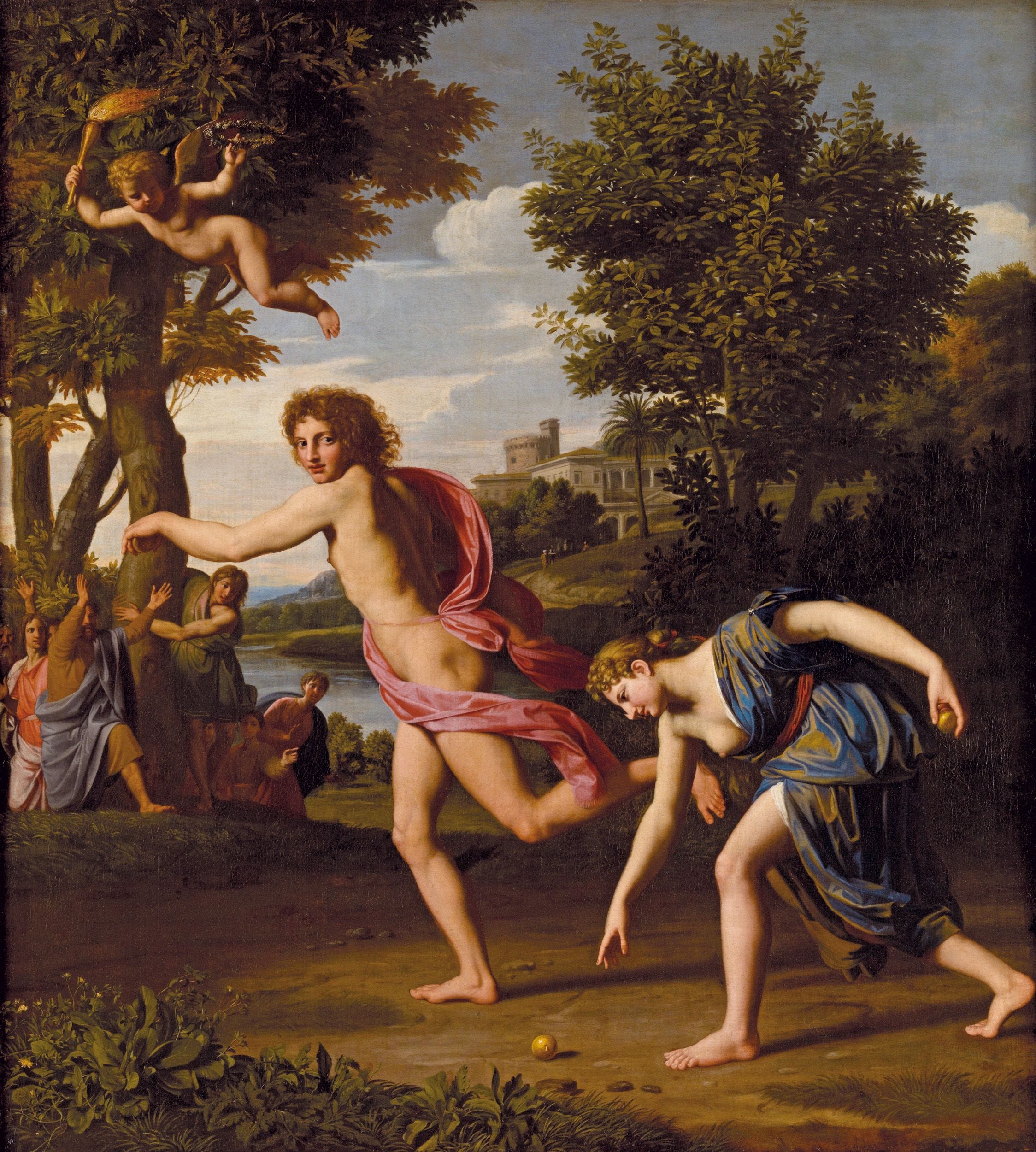
Welcome to new short story series I’m doing! I have written a couple short stories that are pretty long and divided into parts, almost chpaters. I would like to share them, but I think they’re too long for one post, so this is part 1 of “Run, Then”, a Greek mythology retelling centering Atalanta, that mythical female track and field queen whose life was thwarted when she was tricked in a race.
1. The Orchard
In the hour before dawn, when the world still holds its breath, Atalanta wakes to the sound of apples falling.
It is always the sound that wakes her first—a wet, golden thud like something soft collapsing under its own weight.
She pushes herself up from the straw pallet, joints protesting with the stiffness of a body long acquainted with labor and exile. The cottage is shadow-dark except for a faint line of pale blue at the shutter seam, where morning tries to seep through. She rubs her eyes and listens.
Another thud. Then another. And then the long, dragging hush of something moving through the orchard leaves. She waits. Nothing follows. No breath, no growl, no padded footstep. Only silence, too complete to be natural.
“Not today,” she mutters to the dark. Her voice sounds rough, unused, older than she remembers.
She dresses in simple linen, wraps her hair, and takes up the reed-woven basket by the door. The hinges groan as she pushes the door open, and the chill bites at her immediately, the kind that feels cleaner than pain. Mist moves across the orchard like a pale, restless animal, slipping between the trees and brushing her ankles with cold tongues.
The trees themselves stand crooked and ancient, their branches heavy with overripe fruit. Apples of impossible gold—bright as hammered sunlight when they first form—now sag and bruise with decay. Some rot on the branch, turning copper at the edges. Others split open under their own weight and drop to the ground before she can gather them.
She steps onto the soft earth, and something like electricity pulses faintly through her soles. The orchard always feels awake. Watching. Breathing with her.
“Not today,” she says again, though to whom she’s speaking she could not say.
She bends to collect a fallen apple. Its skin, still warm, yields under her touch. A thin seam splits along its surface, and a glimmer of gold—true gold, divine gold—seeps from within before darkening back to rot. She wipes her fingers on her tunic.
Behind her, the faint drag through the leaves sounds again.
She turns sharply. The orchard is still. She has long since learned that the rustling is not wind. The grove sits in a sheltered valley; the air here is too heavy for wind. What moves the leaves is memory— hers or the gods’, she can never be sure.
She walks between the rows. The morning light rises slowly, staining the mist a wan yellow. Birds do not roost here. Small animals skirt the orchard’s border but do not cross.
She is alone, and yet not alone.
Atalanta kneels beside another fallen apple, this one rotted clean through, its flesh caved inward like a collapsed lung. A ring of tiny footprints surrounds it—pawprints, feline, but spaced too far apart for any living creature. As if something large pressed invisibly against the earth. She presses two fingers to the prints. Cold radiates upward.
“Not today,” she whispers, more gently.
Some mornings the orchard remembers the lion-body the gods tried to trap her in. Other mornings it remembers Hippomenes—his scent, his breath, his silent questions. And some mornings, like this one, it remembers everything.
She rises and makes her way toward the far end of the grove where the earth slopes downward toward the ruins. The old temple walls stand like broken teeth, jutting from the ground in jagged arrangements. Ivy crawls over the stones, clutching them with a fervor that feels too intentional to be natural growth.
Her shadow stretches ahead of her—long, sharp-edged, too broad around the shoulders to be only a woman’s, she remembers the elders saying when she was a girl. She adjusts the basket on her arm and ignores it. The first time she noticed her shadow behaving strangely, years ago, she had wept. Not from fear, but from exhaustion. You can only bear so much change in a lifetime before your capacity for alarm thins into a dull hum.
She moves through the orchard, gathering apple after apple, sorting them into three piles back at her cottage: those still edible, those fit for cider, and those too corrupted by magic to touch again.
These she buries, always beneath the same old tree. Always in the same patch of earth that remembers the moment the gods nearly consumed her whole. She does not look toward that tree now. The memory is present enough without sight.
Instead, she focuses on the tasks of the morning. The rhythm anchors her—bend, lift, sort, breathe. For a woman who spent her youth in motion, constant as wind, she has learned to live slowly. It is the only pace her peace allows.
Another apple drops nearby. A dull, sudden thump.
She stands and watches the tree. The fruit is still. Nothing moves.
“Show yourself,” she murmurs.
Her voice carries strangely in the orchard, as though the branches lean in to hear her better. And then the dream returns, intrusive and unbidden:
Hippomenes calling her name beside the altar, his voice breaking apart as the gods approached. He reached for her—she remembers the desperation in his touch—but when she turned to look at him, his face blurred like water splashed across a painted mask. It is always that way in the dream. No face. Only the shape of a man she once outran and then outlived.
She exhales slowly to banish the memory.
That is when she sees them: fresh footprints in the dirt beneath the nearest tree. Not the ghostly pawprints of the orchard, but human. Booted. Heavy. Multiple sets. A tremor moves through her ribs; not fear, but recognition.
The priests have returned.
She straightens her spine, wipes her palms on her tunic, and breathes in the orchard air—ripe, metallic, sweet with rot.
Let them come, she thinks. This time, she will not bow.
To be continued…
Inspired endlessly by my wonderful friend and writer-comrade, Bradley Ramsey, I offer you today a short musical pairing by a new artist I discovered through TikTok. I call his music “horor classical”.
My debut book, “Turning & Turning”, a short story and poetry collection of Greek mythology retellings, came out in early December 2025. Check it out, if you liked “Run, Then” so far!