
HYLAS!
"He digs at the earth...As if myth were something that could be overturned."

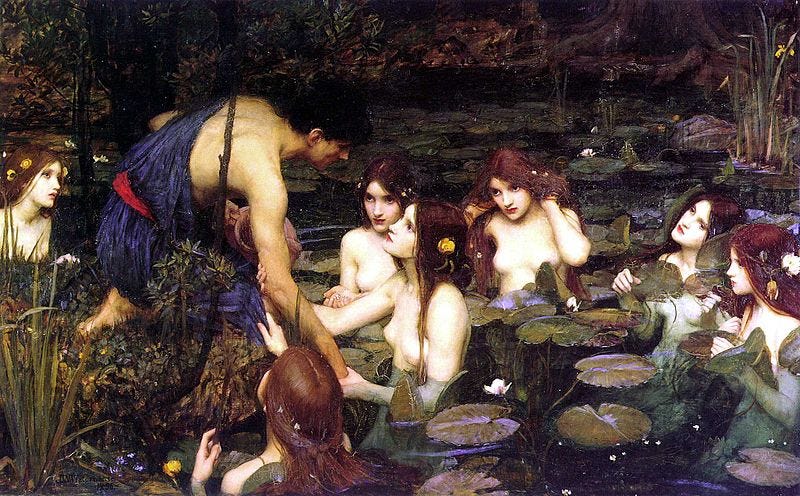
Dramatis Personae:

Herakles—the strongest man alive
Hylas—beautiful, wonderful, absent
Forest—listening
Water—unresponsive
Argonauts—pretending not to watchAt dusk, Hylas goes to the water with a pitcher.
He crosses the clearing
and does not look back.
Herakles watches the place where he disappeared.
He waits,
requiring a strength he had never borne.
When Hylas does not reappear,
he says the man's name once,
softly,
as if it might raise on its own—
Hylas.
The water keeps its smooth face.
He says it louder—
HYLAS.
The forest bristles but does not answer.
Leaves shift,
light thins,
nothing returns.
Herakles understands force.
He understands broken necks,
has strangled serpents
   before his hands were large enough
      to cover their throats.
He has held the sky on his shoulders.
He has carried a lion skin on his back.He has never held silence. It is unbearable.
HYLAS!
The name strikes the trees,
splits itself against bark,
travels outward
and refuses to return.
The Argonauts stand at a distance, watching.
They know when a scene belongs to another character;
they do not intervene—
heroes understand spectacle,
the necessity of grief.
Herakles wades into the water.
It closes around his thighs like fabric.
Pale shapes dart away beneath the surface,
human-like, with long flowing hair
and wild, glassy eyes.
He searches the pool with the same hands
   that once split lions in two.
They come up wet
   and empty.
HYLAS!

HYLAS!
Now the name is torn from him.
It is no longer a call
but an act of will—
volume against destiny.
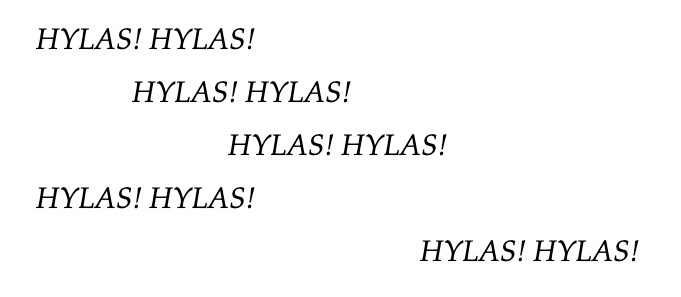
He repeats it as if repetition could summon a body.
As if sound could force flesh to surrender.
As if the world were obliged to answer strength.
Night gathers,
soft and chill against his burning flesh.
The forest grows used to the sound of his voice cracking.
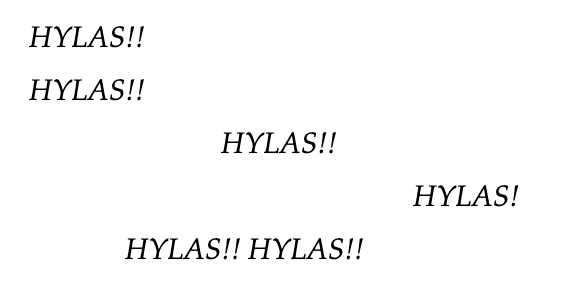
The name begins to fray—
consonants dull,
breaths between syllables lengthen.
He drops to his knees,
shoves his hands in the soil
and begins to dig.
Frantic, desperate,
nails splitting,
blood mingling with the rocky earth.
As if he missed something.
As if the boy might be buried here
instead of the water.
As if myth were a thing
that a hero could overturn.
Hylas—

Please.
The Argonauts board the ship.
This is not the labor
they signed up for.
Oars dip,
shoreline recedes,
and Herakles remains.
Still shouting,
hoarse now,
almost voiceless,
muscles trembling with something besides exertion,
tears cutting tracks through the dirt on his face—
but still calling.
Always calling.
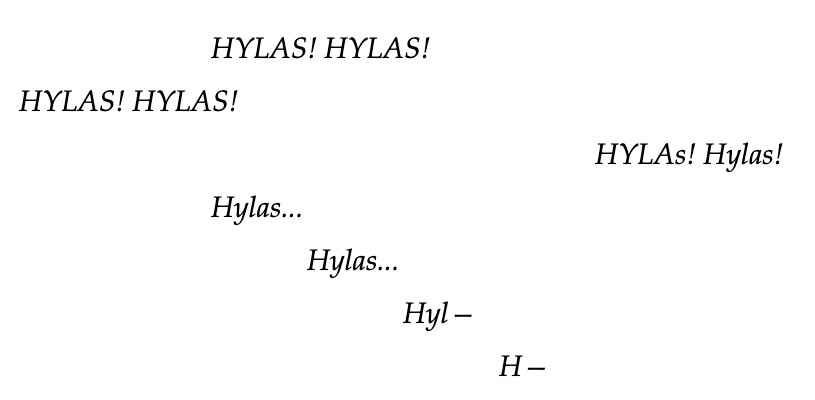
The forest refuses to answer,
the water does not shift,
the echoes grow thin.
And still he calls—
even after the ship is gone,
even after the water forgets
   the shape of the boy
      it swallowed—

His boy.Hylas. Hylas. Hylas. Hylas. Hyl—
Who’s Who: And we’re back! This is a poem I wrote inspired by the story of Herakles and Hylas. I have long been fascinated (re: borderline obsessed) with the stories of male heroes from mythology and their companions. By Ancient Greek standards, their relationship was perhaps more than friendly; and yet, until very recently in academia and outside it, these bonds have gone unexplored. Achilles and Patroclus, Orestes and Pylades (story about them coming soon 😝), Odysseus and Polites and Eurylochus (Ody’s greed is insatiable)—and, recently, Herakles and Hylas. These men consume my dreams.
(CW in this description for murder, family annihilation, and suicide)
In one version of Herakles’ story, he was originally the leader of the group tasked with finding the Golden Fleece. (I believe this took place after his labors, but don’t quote me on that.) The group stopped at an island where Hylas went to go fetch some water. While he was gone, the nymphs in the lake pulled him in and drowned him, pulling him to the bottom and even further, so that even if you looked into the clear-as-glass pool, you would not find his body.
Herakles (Roman: Hercules), waiting for him to come back, was panicked when his friend (read: lover, probably) did not return quickly. He went into the forest to search, calling his name until he lost his voice. He never found Hylas, and stayed so long in the forest searching that the Argonauts left him behind, later finding Jason and the rest of that story continues as we all know it.
Herakles, though, never left the forest. Eventually, he somehow found his way back home, where he had been driven close to madness with loss and grief. Hera, eternally upset at the children of her husband’s dalliances, plagued him with actual madness, causing him to kill his wife, Megara, and their children. When he ‘awoke’ from the madness, he realized what he had done and killed himself.
Hope you enjoy this sad, sad poem! <3
Check out some of my recent Greek mythology retellings:
held too close (Galatea), harvest pantoum (Demeter), Sisters (Antigone and Ismene), The Fruit The Seed The Binding Vow (Persephone)
My debut collection, Turning & Turning, reimagines my favorite Greek myths in poetry and prose. Buy here!