
Run, Then (part 4)
"My clever children...What delightful trouble you’ve brought me.”

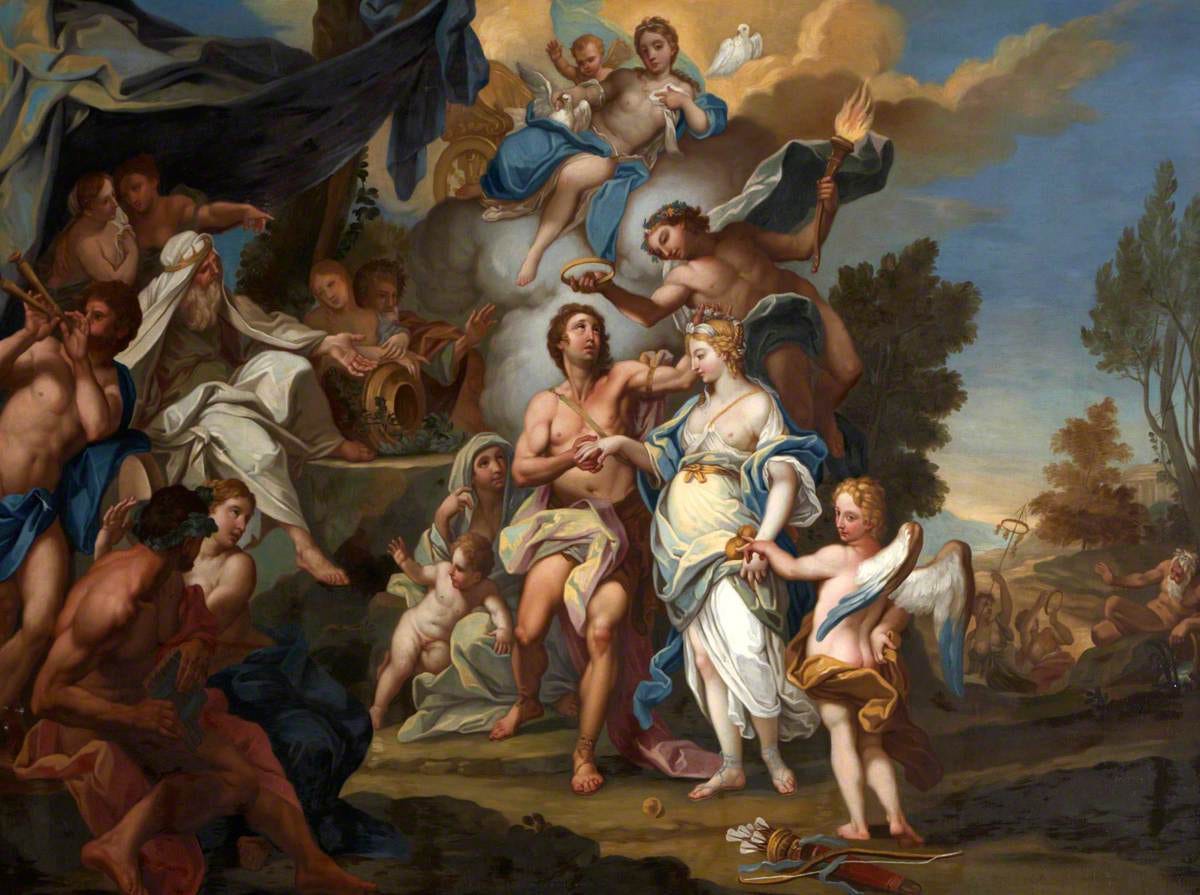
This is the fourth installment in an ongoing series. Please make sure you read the previous ones as well: Part 1, Part 2, Part 3.
4. The Husband
The wedding was not a celebration so much as a sentence carried out in silk.
Atalanta had stood beside Hippomenes at the altar, her wrists still raw from where the ceremonial bindings had been tied too tightly. Frankincense smoke curled around them like a serpent, obscuring the faces of the gathered crowd. Musicians played bright, triumphant notes, but beneath the melody she heard the steady pulse of resentment—hers and theirs.
She had never wanted this marriage.
Hippomenes had never wanted her, not truly. What he wanted was the victory, the proof that he could outwit a woman whose speed had humiliated men stronger and richer than him. He wanted triumph. He got a wife.
After the ceremony, they walked together through a corridor of petals thrown by eager hands. She felt none of it; she felt only the gods’ gaze, heavy as a stone on the back of her skull.
When they reached the privacy of their new chamber, Hippomenes sat at the edge of the cot and stared at his hands as though they were foreign things.
Finally, he spoke.
“I didn’t expect you to hesitate.”
She said nothing.
“I thought you would… pick them up. The apples,” he clarified, shifting uncomfortably. “That’s what she told me. The goddess.”
That startled her into looking at him fully. “Which goddess.”
It wasn’t a question, but he answered as if it were. “Aphrodite.”
Aphrodite had spoken to him? At least he had the decency to look ashamed.
Hippomenes saw her reaction and hurried to continue, as if afraid she might interrupt. “She came to me the night before the race. Said she admired boldness. That she liked contests of wit.” He swallowed. “She said the apples would win me the race if I used them properly.”
Atalanta forced down the bitter taste rising in her mouth.
“The gods don’t give gifts,” she said. “Especially Aphrodite. She offers leverage.”
Hippomenes flinched. “She—she said you wouldn’t be harmed. Only delayed.”
“Well, she lied.”
Silence settled over them. Atalanta moved to the other side of the chamber, putting
distance between them. She could feel Hippomenes’ eyes on her back.
“I didn’t want this,” he said softly.
She turned. “Neither did I.”
He blinked, as though the thought had not occurred to him that her dislike might equal his.
“It’s not that I— I don’t find you—” he gestured helplessly. “You’re… astonishing. Everyone knows that. But I’m not…ready for marriage. I wanted more time.”
She snorted. “You wanted glory.”
He didn’t deny it.
What surprised her more was the quiet grief in his expression. He looked like a boy who had set a snare and caught something he could not bear to kill.
The days that followed were uneasy.
They moved around each other with the careful politeness of strangers trapped in a too-small room. Hippomenes tried to converse—asking about her childhood, her training, whether the mountain wolves truly accepted her as one of their own. She gave him short answers. Not out of cruelty, but because her thoughts felt thick and slow, as though wading through water.
And the wrongness persisted. A prickling beneath her skin, a heat in her teeth as though they were lengthening, a restlessness that kept her pacing long after sundown.
She told no one. Least of all the man she now shared a roof with.
Rumors spread. They always did. Some said she was already pregnant—ridiculous, but gossip liked a good story. Others whispered that she walked the halls at night with eyes that glowed faintly, like an animal’s.
The truth was worse: she could feel something inside her growing. Not a child. A curse.
Then came the first night she felt the shift. It was subtle at first, like a cramp beneath her shoulder blades. She thought nothing of it until she tried to rise from the bed and felt her spine resist her. Her breath hitched.
Hippomenes stirred beside her. “Are you all right?”
She clenched her jaw until the pain passed. “A twinge. Nothing more.”
But it was more.
When she stepped onto the cool floor, her balance swayed. Her toes pressed harder into the stone than they ever had into soil. Her vision sharpened, every detail of the room rendered with unnatural clarity.
The wrongness was no longer subtle. It sang through her bones.
Hippomenes sat up, watching her carefully. “You’re trembling.”
She forced her hands to steady. “I’m fine.”
He didn’t believe her, but he didn’t challenge her either. Fear had made him cautious.
The transformation built slowly. Over the following days, Atalanta’s muscles ached more deeply than any training wound. Her skin felt too tight, stretched over something larger than herself. At night, she dreamt of running on all fours, her breath hot and metallic, her throat open in a sound that was not a scream and not a roar.
Hippomenes noticed. He tried to hide it, but she saw him watching her lingeringly, warily, as though waiting for her to split open.
Finally, after a week of her sleepless pacing, he approached her in the courtyard.
“I think we should leave,” he said quietly. “The people here are… frightened. And I don’t know what’s happening to you, but it feels wrong to stay.”
She stared at him. What he was asking of her…She had never run from anything in her life. The very thought was inconceivable.
“You want to flee?”
“Yes. With you.”
The words were sincere. And for the first time, she pitied him. He had not asked for a cursed bride. He had asked for a victory. He had not known the price.
They fled in the night. No attendants, no escort. Just the two of them and a borrowed horse. The moon cast their shadows long across the road—her shadow too broad, too angular, too wild.
They traveled until they reached the old temple in the valley, where pilgrims once sought Aphrodite’s blessing before the goddess had turned the place into her graveyard of broken vows.
Atalanta felt the pull immediately. The ground hummed with recognition. With appetite.
Hippomenes dismounted first, helping her down with trembling hands.
“Maybe here,” he said softly, “we can pray for—”
But the words died. The air darkened. The earth shuddered beneath them. A voice—silk over steel—filled the valley.
“My clever children,” Aphrodite purred. “What delightful trouble you’ve brought me.”
Atalanta felt her ribs tighten, her spine arch painfully. She gasped, clutching at her sides as the transformation surged.
Hippomenes reached for her. “Atalanta—!”
The goddess’s laughter slid around them like smoke. “You didn’t think your little trick came without consequence, did you?”
Atalanta fell to her knees. Her nails split. Her teeth sharpened. Her vision flared gold.
And Hippomenes, poor foolish Hippomenes, was the first to scream.