
Run, Then (part 6)
"The apples fall faster. Something is coming."

I have arisen from my cavern of academia to bring you the next installment in Run, Then! I hope you enjoy this one. This is part of a series, so please check out the previous parts (1-5) before this one. Love yall <3
Find the rest of the Atalanta series here:
part 1, part 2, part 3, part 4, part 5
This is a series I started because I wanted to explore what Atalanta’s life was like after the race, after the transformation, after the death of Hippomenes. Myth does not pay much attention to the lives of those who survive, and I wanted to give Atalanta time to tell the story of what happened after her story.
For those familiar, there are, technically, two Atalantas in Greek mythology: One who is a huntress for Artemis, and another who is athletic and consistently beats men in footraces. This latter is the one this series is based on.
Hope you all enjoy!
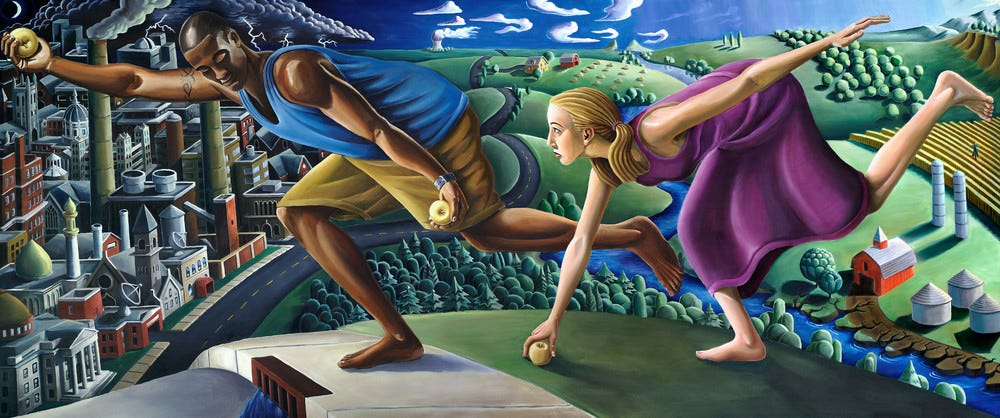
6. The Rot
The day after the priests’ visit, the orchard begins to rot in earnest.
It starts with the sound—soft, continuous, like rain on a distant roof. Atalanta steps outside to find apples dropping one by one, falling too fast, too heavily, hitting the earth with wet thuds that remind her uncomfortably of flesh. Some burst on impact, splattering gold- tinged pulp across the roots. Others land intact but collapse seconds later as if punctured from within.
She crouches beside one, places her fingertips lightly on the bruised skin. Heat pulses beneath the surface. Not the warmth of a living fruit ripening under sun. This is divine rot— ancient power breaking down and fermenting into something new.
“Not yet,” she murmurs. “Not today.”
A breeze moves through the orchard. No—not a breeze. There is no wind in this valley. The branches shift of their own accord, releasing more fruit. The air thickens with a sweet, sick smell, like honey left too long in a jar.
Her stomach twists. She knows this scent. It clung to the temple the night Hippomenes died. It clung to her skin for years afterward, no matter how many times she washed in river water cold enough to numb bone.
She stands quickly, grabs her basket, and moves through the rows, gathering what she can. The rotted apples go into a separate crate—one she will bury—while the salvageable fruit fills the woven basket. But today, there is little worth saving.
The orchard hums around her, a low vibration like distant thunder. She feels it in her hybrid bones—whatever the gods made her into, it has not stopped reverberating through her life.
She wipes sweat from her brow, though the day is cool. Her breath fogs lightly in front of her despite the sunlight.
The apples fall faster.
Something is coming.
At midday, she hears the crunch of footsteps at the edge of the grove. Not the light, skittering drag of animal paws or the deep tread of mythic memory. These steps are human, deliberate.
She turns.
Brother Melios stands at the boundary, his robes dusted from the climb, his dark hair pulled back with a strip of worn leather. His expression is uncertain—caught between duty and fear.
“You’re early,” she calls.
He swallows. “High Servant Thestor does not know I’m here.”
Atalanta sets down her basket. “Why am I not surprised?”
He approaches slowly, stopping a few paces away as though the orchard itself forms a barrier he is reluctant to cross.
“I dreamed again,” he says. “Last night. The same vision. You, the orchard… and the apple buried beneath the oldest tree.”
Atalanta’s jaw tightens. So that part had reached him too.
“What did you see exactly?” she asks.
Melios hesitates. His fingers twitch at his sleeves. “A glow. Like embers in the dark. And a voice—faint, broken—calling your name.”
Atalanta’s breath stills.
Hippomenes’ voice had not been a voice, not truly. It had been a memory escaping a dying curse, fragmented and incoherent. But if the apple still held traces of him—of the spell, of that night—then the rot spreading through the orchard was not just decay.
It was awakening.
“You shouldn’t be here,” she says.
Melios steps forward despite her warning. “Thestor believes removing you from the valley will calm the dreams. That once you’re under priestly care—”
She snorts. “Once I am caged.”
“I don’t want that,” he says quickly. “I don’t. That’s why I came. To warn you.”
Atalanta studies him. He is young, painfully earnest, still trying to reconcile myth with the woman before him. His fear is real, but so is his compassion. A rare combination among the clergy.
“What else did you see?” she asks quietly.
His gaze drifts toward the orchard, toward the oldest tree with its twisted trunk and gnarled branches.
“You were digging,” he whispers. “With your hands. The ground was trembling. And when you uncovered it…the apple was alive.”
A shiver runs through her.
The dreams are not prophecy. They are memory. Something in the buried apple—some remnant of divine power, or curse, or both—is stirring. And if the priests know even a fraction of this, their insistence on relocating her is not merely bureaucracy.
It is fear.
Atalanta lifts her chin. “Go back to your order, Melios. Tell them nothing.”
He flinches. “I can’t protect you if—”
“You can’t protect me at all,” she interrupts gently. “But you can protect yourself. Go.”
Melios hesitates one moment longer, searching her face for something — reassurance, gratitude, maybe absolution. He finds none.
He bows his head. “May the Mother watch over you.”
She doesn’t bother responding. His god has never watched her. Never will.
Melios turns and retreats down the path. She waits until his footsteps fade. Then she grips the handle of her shovel.
The oldest tree stands alone. Not because she planted it that way, but because nothing grows within several paces of it. The soil is too saturated with magic—burned, sick, fertile with something that is not life and not death.
A breeze passes through the branches, carrying the faint scent of lion fur.
Atalanta steels herself and begins to dig.
The earth resists at first, as though unwilling to yield what she interred decades ago. She drives the shovel deeper, hitting roots, rocks, pockets of soil that hum faintly with the orchard’s strange life.
Sweat beads at her temple. Her muscles ache. Her partially god-touched bones vibrate with the tension of memory. She digs until the soil shifts from brown to a faint metallic shimmer, flecked with gold dust.
Her breath catches. She sets aside the shovel and digs with her hands. The ground is warm around her fingers, pulsing faintly, like a heartbeat. She scrapes away the last layer of soil until her nails hit something smooth, cool, and impossibly bright.
The apple.
Still gold. Still whole. Still humming with the residue of divine spite. But not the crisp gold of the race. This is dampened, mottled, streaked with rot around the stem. It has decayed— but not died.
Atalanta lifts it carefully. It is heavier than she remembers. And when she presses her thumb to its surface, it throbs.
A whisper escapes the fruit. A fractured sound, unintelligible but unmistakably familiar. Hippomenes. Her heart lurches.
“Not now,” she whispers. “Not again.”
She rises from her knees, clutching the apple, and the ground quivers beneath her. The orchard reacts instantly—branches rustling, fruit falling in rapid succession, roots tightening like fists beneath the soil. A ripple of divine energy sweeps the valley.
And then—
Footsteps. Dozens of them.
Atalanta tucks the apple against her ribs and turns to the edge of the orchard. Thestor stands there with four priests behind him. They have come early. They have come prepared. And the ropes in their hands are not ceremonial.
“Lady Atalanta,” Thestor calls, his expression grim. “By order of the Council, you are to come with us.”
The orchard goes still. Atalanta says nothing.
But the apple in her arms begins—very softly—to glow.
My debut collection, Turning & Turning, is available for purchase!